The Wabi-Sabi Advantage: Why Imperfectly Human is the Future of AI.
In a world chasing flawless automation, discover why our uniquely human imperfections are the key to unlocking the true potential of artificial intelligence.
7/27/20255 min read

The Wabi-Sabi Advantage: Why Imperfectly Human is the Future of AI.
In a world chasing flawless automation, discover why our uniquely human imperfections are the key to unlocking the true potential of artificial intelligence.
Ever find yourself staring into the digital abyss, feeling like the AI overlords are just a little too… polished? Too devoid of the delightful stumbles and charming inconsistencies that make us, well, us? What if the secret to truly unlocking AI's potential lies not in eradicating its flaws, but in embracing them?
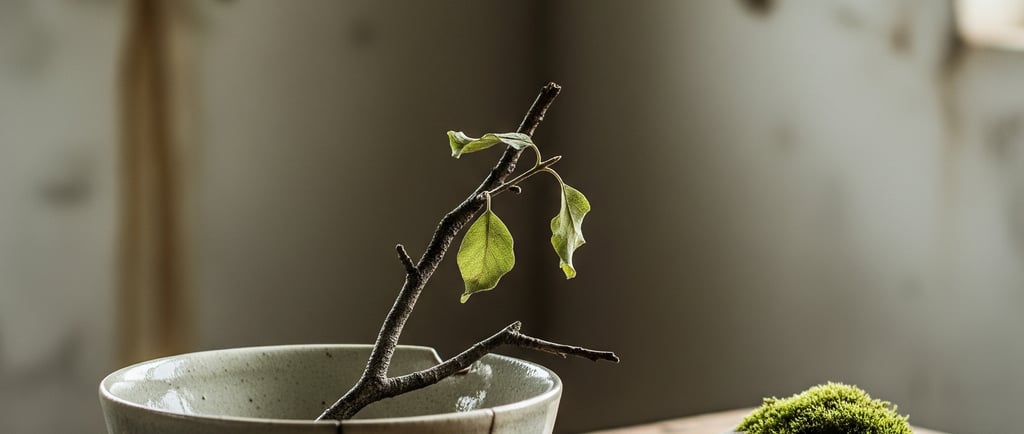
Let's talk Wabi-Sabi. It's that Japanese philosophy that whispers of beauty in imperfection, finds grace in transience, and celebrates the poetry of natural cycles. Think of a beloved, cracked teacup, its imperfections telling a story of countless shared moments, rather than a sterile, mass-produced mug fresh from the factory. Now, dare to apply that lens to artificial intelligence. The proposition isn’t about intentionally building buggy or unreliable AI, understand. It's about a radical shift in design – engineering systems that are more robust, more adaptable, and ultimately, more profoundly useful precisely because they aren't shackled to the pursuit of cold, calculating perfection.
So, what is Wabi-Sabi, beyond a trendy aesthetic? In the human realm, it’s the celebration of imperfection, incompleteness, asymmetry, and the ephemeral nature of existence. It's about recognizing authentic beauty, the kind that accrues over time and experience, not the manufactured gloss of the showroom. Consider a perfectly worn pair of jeans, molded to the wearer's unique form and bearing the marks of countless adventures. Or a hand-thrown ceramic mug, its slight irregularities a testament to the artist's touch. Or an old wooden cabin, weathered and worn but radiating a sense of warmth and history. These objects possess a character, a soul, born from their "flaws."
Now, let's delve into why our AI might desperately need a dose of this philosophical medicine – the "Advantage" part, if you will. The reality we inhabit isn't a neat, pre-packaged binary of 0s and 1s. It's a chaotic, ever-shifting landscape of ambiguity, nuance, and situations stubbornly resistant to clear-cut answers. An AI imbued with the spirit of Wabi-Sabi might be far better equipped to navigate this complexity.
Furthermore, imperfection isn't synonymous with failure; it's a source of invaluable data. Imagine AI designed with Wabi-Sabi principles, capable of learning organically from its "mistakes" or unexpected inputs. Instead of crashing and burning when confronted with the unforeseen, it adapts, evolves, and emerges stronger.
And then there's the crucial element of relatability. Who genuinely trusts a machine that proclaims its own infallibility? An AI that acknowledges uncertainty, that displays a touch of "humanness" through its imperfections, might foster greater empathy and trust from users. It feels less like an alien overlord and more like a helpful, if sometimes quirky, assistant.
Finally, consider the potential for creativity and innovation. True breakthroughs often arise from challenging established norms, from seeing beauty in the unconventional, from embracing the unexpected. Could Wabi-Sabi serve as a muse, inspiring the development of truly groundbreaking AI applications that transcend the limitations of conventional thinking?
Let's take a brief (and admittedly somewhat speculative) stroll through an alternate history of AI, one where imperfection wasn't a dirty word. In the early days, the prevailing ethos was "Perfection or Bust." The relentless pursuit of flawless logic, pristine data, and perfect outcomes was the driving force. Any deviation from this ideal was deemed a bug, an anomaly to be ruthlessly squashed.
But now, we're witnessing a paradigm shift – a growing realization that "perfect" AI often flounders when confronted with the messy, unpredictable realities of the human world. This nascent Wabi-Sabi counter-movement is gaining momentum, fueled by a desire for AI that is not just intelligent but also adaptable, resilient, and genuinely helpful. (Granted, there are no ancient scrolls dedicated to AI Wabi-Sabi just yet, but give it time! The seeds are being sown.)
Who, then, is currently drinking the imperfect Kool-Aid? It's a diverse group, including AI ethicists grappling with the implications of increasingly powerful technology, artists exploring the creative potential of imperfect algorithms, designers seeking to create more human-centered interfaces, and a handful of forward-thinking engineers willing to challenge conventional wisdom.
Of course, skepticism abounds. Many traditional AI developers still view imperfection as a fundamental weakness. "Why would you intentionally design for flaws?" they ask, clinging tightly to their meticulously crafted algorithms.
As for early applications, we're largely in the realm of hypothetical scenarios. Imagine AI that generates unique, slightly irregular works of art, chatbots that openly acknowledge uncertainty rather than feigning omniscience, or adaptive systems that gracefully handle incomplete data rather than crashing in a fit of digital pique.
Inevitably, this raises some thorny "But What About...?" questions. Chief among them is the issue of safety. "You want my self-driving car to be imperfectly human?!" the hypothetical concerned citizen cries. It's crucial to clarify: This isn't about advocating for unsafe systems. It's about embracing robust adaptability in non-critical scenarios, allowing AI to learn and improve even in the face of unexpected events.
Another challenge lies in defining "good" imperfection. Where do we draw the line between a charming quirk and an outright malfunction? It's a delicate balancing act, requiring careful consideration of context and potential consequences.
There's also the risk of the "Lazy AI" accusation. Some might argue that embracing imperfection is simply an excuse for poorly built systems, a justification for cutting corners rather than a genuine philosophical commitment.
And perhaps most concerningly, there's the potential for amplified human bias. If AI learns from human "imperfections," could it inadvertently perpetuate and amplify existing societal biases rather than helping us to overcome them?
Looking ahead, what might the perfectly imperfect future of AI hold? Imagine AI not as a competitor striving to replace human capabilities, but as a collaborator, genuinely complementing our strengths and weaknesses, filling the gaps in our knowledge, and offering unique perspectives that we might otherwise miss.
We might see the rise of what could be termed "Artisan AI" – less about mass-produced, one-size-fits-all solutions and more about customized, nuanced, and perhaps even "soulful" AI tailored to specific needs and contexts.
Beyond the confines of the laboratory, Wabi-Sabi principles might profoundly influence how we interact with AI in our daily lives, making it feel more natural, more intuitive, and less alienating.
Ultimately, acknowledging AI's inherent "imperfections" might lead to a more humble and responsible approach to its development and deployment, fostering a greater awareness of its limitations and potential biases.
In conclusion, the Wabi-Sabi advantage isn't just a whimsical philosophical notion; it's a practical, empathetic, and potentially revolutionary path forward for artificial intelligence.
Perhaps the true future of AI lies not in creating flawless machines, but in creating intelligent companions that, much like ourselves, are perfectly imperfect.
What are your thoughts? Could you envision an AI that embraces its flaws? Share your insights in the comments below!